Insights from the community empowerment workshops
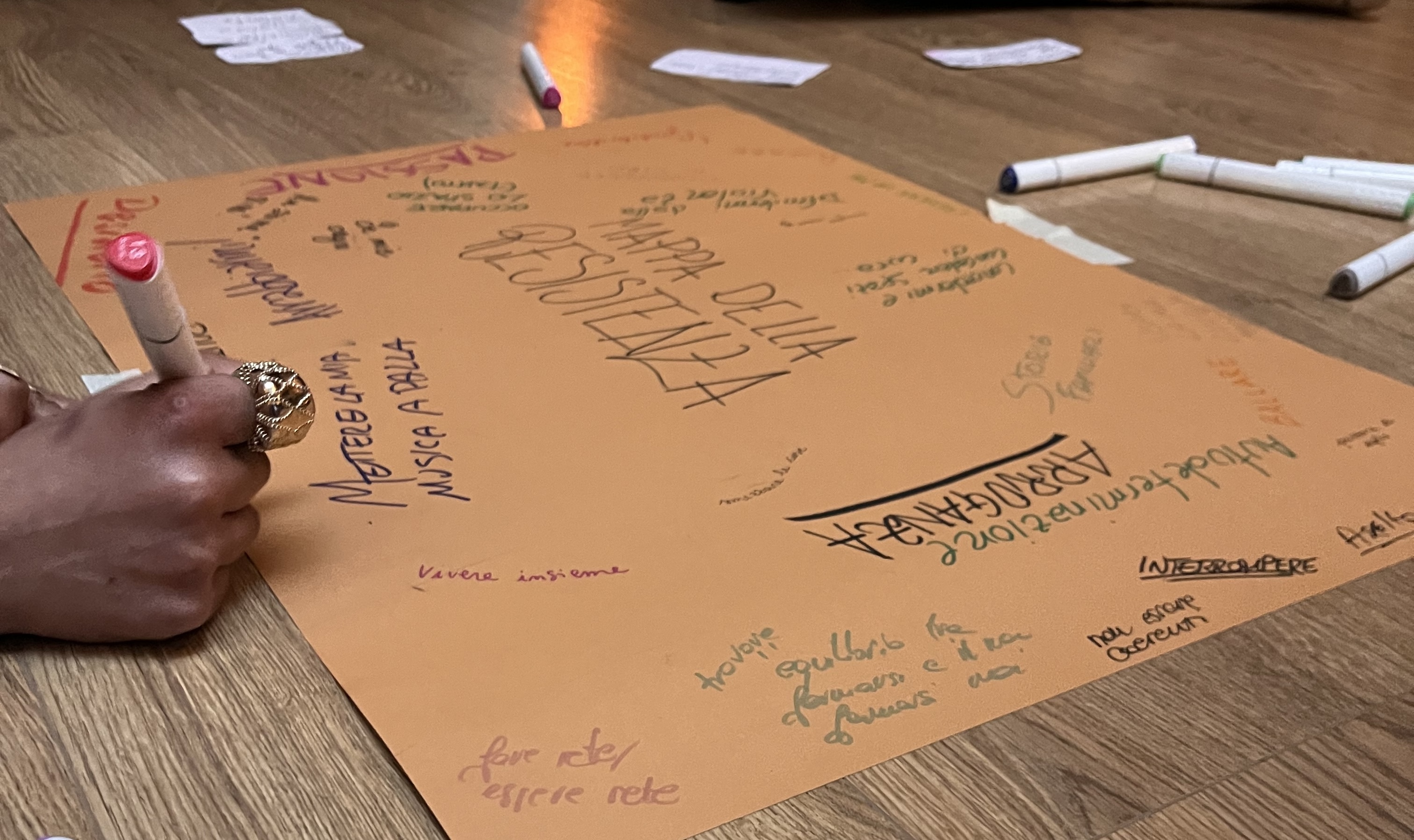


As part of the EQUAL project, two Community Empowerment pathways have been launched, addressed respectively to the Roma and Sinti community and the migrant community.
The ten sessions were built around the direct experiences of the participants, ensuring a safe space for sharing, listening and transformation. The workshops were designed to challenge dominant narratives, address conflicts both internal and external to the communities, and develop practices of self-representation and collective advocacy, placing reflections on the intersectionality of everyday systemic oppressions at the core, through a variety of activities ranging from sharing circles to role play.
Privilege and intersectionality in the migrant community
One of the sessions dedicated to the migrant community focused on intersectionality, privilege, sense of belonging and new narratives. To break the ice, the session opened with an interactive activity – the “Walk of Privilege” – which proved to be one of the most intense and meaningful exercises of the workshop pathway, offering a concrete representation of social inequality and intersectionality. This experiential activity involves asking participants to stand side by side in a horizontal line – an apparently equal starting point for everyone. The facilitator then begins reading a series of statements: “If your parents attended university, take a step forward”; “If you feel safe when law enforcement is present, take a step forward.” Each person moves accordingly, stepping forward or staying in place. As the activity unfolds, the initial line transforms: those who benefit from certain privileges move further and further ahead, while those embodying specific conditions related to social class, background or gender remain behind. The gap becomes visible, tangible, impossible to ignore. What clearly emerges is that privilege does not operate on a single axis – the same person may step forward for their level of education and step back for their origins, reflecting the complexity of intersectional oppressions. The exercise thus challenges the myth of meritocracy, shifting the focus from individual effort to the structural conditions that intersectionally influence each person’s opportunities.
Gender roles in the Roma and Sinti community
The workshop for the Roma and Sinti community on “gender and the Roma body” also began with role play, experiential exercises and non-formal education methods. These approaches helped participants explore privilege, social positioning, different perspectives and various forms of oppression in an interactive and engaging way. Drawing on these experiences, a reflection was initiated on gender roles within Italian society through an intersectional lens, particularly in connection with belonging to the Roma and Sinti community. Discussions centred on imposed social roles, stereotypes and the perception of Roma men within communities. Equally, participants examined the expectations placed on Roma women, highlighting how gender and ethnicity intertwine in determining access to opportunities, autonomy and justice. Particular attention was given to the experiences of LGBTQIA+ Roma people, who often face marginalisation both within and outside their own community, finding themselves in complex positions of conflict and exclusion.
Upcoming Events
In the coming weeks, the two workshop pathways that began in February will come to a close. However, the EQUAL project will continue with further activities, starting with three focus groups to be held in May, involving members of the migrant community, the Roma and Sinti community, and legal professionals.
The EQUAL project is co-funded by the European Union under the Citizens, Equality, Rights and Values (CERV) programme.